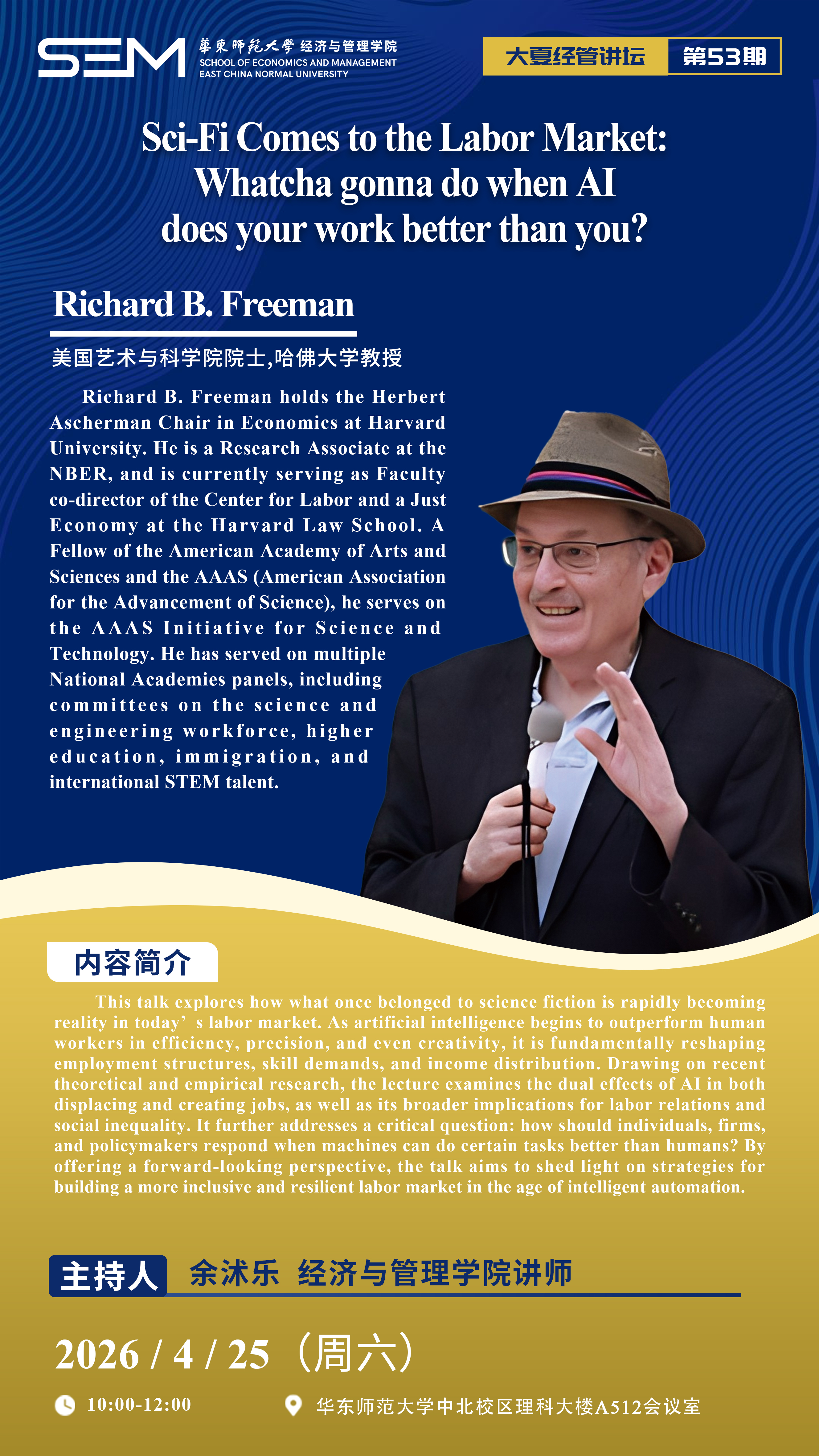
时间:2026年4月25日(周六) 10:00-12:00
地点:理科大楼A512报告厅
题目:Sci-Fi Comes to the Labor Market: Whatcha gonna do when AI does your work better than you?
报告人:Richard B. Freeman 美国艺术与科学院院士,哈佛大学教授
主持人:余沭乐 经济与管理学院讲师
内容简介:
This talk explores how what once belonged to science fiction is rapidly becoming reality in today’s labor market. As artificial intelligence begins to outperform human workers in efficiency, precision, and even creativity, it is fundamentally reshaping employment structures, skill demands, and income distribution. Drawing on recent theoretical and empirical research, the lecture examines the dual effects of AI in both displacing and creating jobs, as well as its broader implications for labor relations and social inequality. It further addresses a critical question: how should individuals, firms, and policymakers respond when machines can do certain tasks better than humans? By offering a forward-looking perspective, the talk aims to shed light on strategies for building a more inclusive and resilient labor market in the age of intelligent automation.
报告人简介:
Richard B. Freeman holds the Herbert Ascherman Chair in Economics at Harvard University. He is a Research Associate at the NBER, and is currently serving as Faculty co-director of the Center for Labor and a Just Economy at the Harvard Law School.
Professor Freeman is a Fellow of the American Academy of Arts and Science and the AAAS (American Association for the Advancement of Science). He is currently serving on the AAAS Initiative for Science and Technology. He has served or is serving on 12 Panels and Boards of the U.S. National Academy of Science, including The NAS Panel to Evaluate the National Center for Science and Engineering Statistics Approach to Measuring the Science and Engineering Workforce, The Board of Higher Education and Workforce (BHEW), The Committee on Understanding the Engineering Education-Workforce Continuum (NAE), The Committee on Assuring a Future U.S.-based Nuclear Chemistry Expertise, The Committee on National Statistics Panel on Developing Science, Technology and Innovation Indicators for the Future, The Committee on Capitalizing on the Diversity of the Science and Engineering Workforce in Industry, The Committee on National Needs for Biomedical and Behavioral Scientists, The Committee on Demographic and Economic Impacts of Immigration, and the joint NAS, NAE and IM study on Policy Implications of International Graduate Students and Postdoctoral Scholars in the U.S. United States.