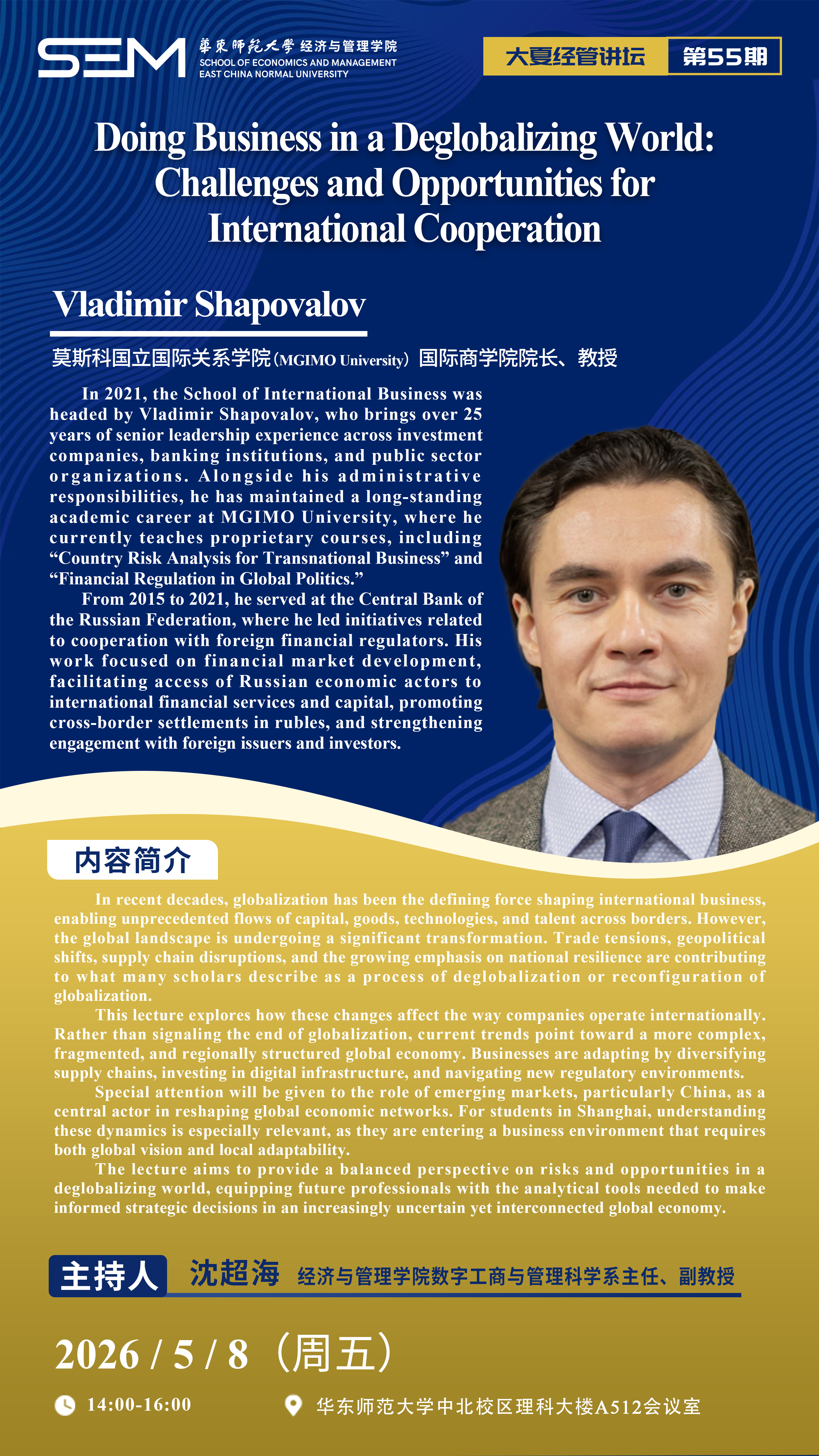
时间:2026年5月8日(周五)14:00-16:00
地点:理科大楼A512会议室
题目:Doing Business in a Deglobalizing World: Challenges and Opportunities for International Cooperation
主讲人:Vladimir Shapovalov莫斯科国立国际关系学院(MGIMO University)国际商学院院长、教授
主持人:沈超海 副教授
内容简介:
In recent decades, globalization has been the defining force shaping international business, enabling unprecedented flows of capital, goods, technologies, and talent across borders. However, the global landscape is undergoing a significant transformation. Trade tensions, geopolitical shifts, supply chain disruptions, and the growing emphasis on national resilience are contributing to what many scholars describe as a process of deglobalization or reconfiguration of globalization.
This lecture explores how these changes affect the way companies operate internationally. Rather than signaling the end of globalization, current trends point toward a more complex, fragmented, and regionally structured global economy. Businesses are adapting by diversifying supply chains, investing in digital infrastructure, and navigating new regulatory environments.
Special attention will be given to the role of emerging markets, particularly China, as a central actor in reshaping global economic networks. For students in Shanghai, understanding these dynamics is especially relevant, as they are entering a business environment that requires both global vision and local adaptability.
The lecture aims to provide a balanced perspective on risks and opportunities in a deglobalizing world, equipping future professionals with the analytical tools needed to make informed strategic decisions in an increasingly uncertain yet interconnected global economy.
报告人简介:
In 2021, the School of International Business was headed by Vladimir Shapovalov, who brings over 25 years of senior leadership experience across investment companies, banking institutions, and public sector organizations. Alongside his administrative responsibilities, he has maintained a long-standing academic career at MGIMO University, where he currently teaches proprietary courses, including “Country Risk Analysis for Transnational Business” and “Financial Regulation in Global Politics.”
From 2015 to 2021, he served at the Central Bank of the Russian Federation, where he led initiatives related to cooperation with foreign financial regulators. His work focused on financial market development, facilitating access of Russian economic actors to international financial services and capital, promoting cross-border settlements in rubles, and strengthening engagement with foreign issuers and investors.